Showing posts with label center pivot irrigation systems. Show all posts

Friday, September 12, 2014

The best crop insurance is irrigation

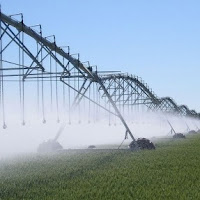
center pivot irrigation system
Irrigation is one of the most important factors that contribute to agricultural prosperity. Uniform and timely applications of water to crops help to avoid water losses in long dry seasons, and produce revenues by increasing crop yields in normal seasons. Irrigation creates more predictable yields and a reduction in risk that is so important to farmers. In fact, we might even say that the best crop insurance is irrigation.

Most farmers started to invest in irrigation after the Second World War, primarily focusing on high-value vegetable crops and not on grain crops. The irrigation of potatoes, sweet corn, beans, tomatoes and other vegetables improved yield and quality. In those days, irrigation systems were moved by hand across the field and water usually came from ponds.

Center-pivot systems began to appear, irrigating larger acreages without the need for hand labor.

With the emergence of the poultry industry, the demand for grain corn as a primary feed source grew rapidly. A lot of farmers responded by investing in center pivot irrigation systems. But this irrigation system is not only useful to feed poultry industry, but it also mitigates nutrient movement to groundwater and streams by enhancing the uptake of nutrients by crops.

Friday, July 26, 2013

Pivot irrigation systems are bad for roads

center Pivot watering the road
The complaint is nothing new, but it usually doesn't come from just one farmer. Everybody knows that Pivot irrigation machines are the best solution for crops but are bad for roads.

During the Mississippi County Commission that took place on Thursday, the commissioner said that he received a complaint about some center pivot irrigation systems hosing down roads with the end guns. When the center-Pivot water is hitting gravel roads, it erodes and ends up making ruts there. Besides, the water from end guns also damages paved roads.

The person who made the complaint wants that this farmer to not let his irrigation end guns hit the road and wants other farmers to have the same consideration for county property.

The problem can be solved in five minutes, just by turning off the end gun. But it may not be the hassle of turning off the end gun as much as not wanting to leave three to five acres without irrigation.

Tuesday, June 12, 2012

Electric pivots versus hydrostatic systems

Electric pivot systems
There are five major manufacturers of center pivot irrigation systems and irrigation technology: T-L Irrigation, Valley (also known as Valmont Irrigation), Raintex Irrigation, Reinke and the Lindsay Corporation. 
Center pivot systems were originally designed to operate on square fields. With the introduction of electric drive machines, center pivots started to be used on many field shapes.
T-L Irrigation manufactures hydrostatic Pivots, (the machine is powered by water propelling the pivot around the field).

The other manufacturers' equipment is powered by 480 volt electricity. The propelling motors and other equipment start and move forward when told to do so by sensors, not in a continuous motion.

Center-Pivot irrigation: benefits to the crop


Many crops around the world take benefit from center pivot irrigation: soybeans, corn, sunflowers, edible beans, sugar beets, alfalfa, wheat...Center pivots have been used successfully in very large fields, with the pivot itself being as much as one-quarter mile in length.
The sprinkler heads are positioned along its length. There are many different nozzle configurations available. Big guns can be placed at the end of the pivot overhang to allow the water system to reach even the farthest edges of a field.

Typically pivots work on flat fields, but even fields can benefit from this type of irrigation system. Many farmers are finding that center pivot irrigation satisfies many of their crops' consistent water needs.

Friday, November 19, 2010

Two center Pivots to put out a cornfield fire

Center Pivots to put out a cornfield fireThree fire departments responded to cornfield fire near St. Libory (Illinois, US) last saturday. St. Libory Volunteer Fire Chief Troy Leschinsky said a cornfield fire apparently started by a combine was put out partly with the help of two center pivot irrigation systems that were turned on after the field caught on fire.
The fire was several miles west of U.S. Highway 281 on Highway 58. The cornfield that caught fire was south of Highway 58.
Leschinsky said the fire, which was called in at about 5:40 p.m., was also put out through the efforts of firefighters and equipment from the St. Libory Volunteer Fire Department, Dannebrog Volunteer Fire Department and Grand Island Rural Volunteer Fire Department.
Leschinsky, who was still overseeing firefighters as they continued to douse hot spots from the extinguished fire, said he did not know how much, if any, damage was done to the combine. He said the fire was quite noticeable for a time because of the heavy smoke it generated.

Thursday, January 15, 2009

Center pivot system ruined by vandals

A center pivot system was destroyed by vandals in what York County Sheriff's Lt. Paul Vrbka called "probably one of the worst cases of criminal mischief" he has seen. Based on the value of the damage alone — about $30,000 or more — that may be true.
The irrigation system, in a rural area between Henderson and McCool Junction, was vandalized sometime Saturday. "They turned it on, full blast, and left it," Vrbka said. "It ran until it completely froze up, the pipes broke and the entire structure collapsed."

Tuesday, November 25, 2008

Evaluation of a Center Pivot irrigation system

Here is the evaluation abstract of a central Pivot irrigation System (CPIS), made in Brazil from a technical and economic point of view. The profitability of the system was simulated using real data obtained from a farm located in Chile, projected over a time horizon of ten years.
Internal Rates of Return were estimated on two crops that frequently use CPIS maize for seed and maize-for grain, assuming a decreasing capital allocation and an increasing governmental subsidy, in the terms provided by Chilean Law 18.450.
From a technical standpoint, results showed that the operation parameters agreed with the specifications of the manufacturer. The Hermann and Hein Coefficient of Uniformity obtained was 86%, classifying the area irrigated as «well watered».
The Distribution Uniformity parameter obtained was 79%, an adequate result for the crop and soil conditions of the test.
The Internal Rate of Return obtained for maize for-seed varied from 23% to 103% for the range of 100% to 25% of self-financing.
For the case of maize-for-grain the investment is profitable only with a maximum of 70% of capital allocation from the part of the farmer, implying that the minimum subsidy required from the part of the State is 30%.

Wednesday, October 15, 2008

Fathers of Center Pivot Irrigation (IV)

Valmont Industries, Inc.
Valley Manufacturing Company (Valmont Industries, Inc.) was founded in 1946 by Robert Daugherty.
He invested his entire life savings to start the company, which manufactured farm elevators, hay rakes, wagon hoists and tractor front end loaders.
In 1954, he acquired patented manufacturing and sales rights for self-propelled irrigation system from farmer Frank Zybach.
Advancements in technology like linear move systems, hot dip galvanizing, low-pressure nozzles, and computerized pivot panels has made Valmont the largest manufacturer of center pivots in the world.

Monday, October 13, 2008

Fathers of Center Pivot Irrigation (III)

T-L Irrigation Company.
T-L Irrigation Company's founding father, LeRoy Thom was raised on a farm in Ravenna, Nebraska. Before founding T-L Irrigation in1955, Thom worked a wide variety of farming jobs from custom combining to irrigation engineer. Today, the family based company has 250 employees and sells thousands of pivot irrigation systems in 44 states and in more than 30 countries. Thom's farming background is what sets his company apart from other irrigation manufacturers. He stresses that before anything else he is a farmer and all newproducts are tested on his family's farm before being sold.

Tuesday, September 9, 2008

Pivot water use in Nebraska

Center pivot irrigation systems consume a lot of water in Nebraska. 
Municipal supplies, domestic users, industries, commercial businesses, livestock and power plants are among the users of Nebraska’s water resources. None, however, use as much of Nebraska’s water as farmers irrigating their crops.
A new educational effort by University of Nebraska-Lincoln Extension seeks to inform center pivot irrigation operators on best practices aimed at reducing water consumption. In an unusual display of camaraderie, the major competing players in Nebraska’s center pivot irrigation industry have joined forces to help in the effort.
Valmont Irrigation of Valley, Reinke Manufacturing Co. of Deshler, T-L Irrigation Co. of Hastings and Lindsay Corp. of Lindsay will work with their dealers to hold educational sessions this winter for center pivot operators.
The way center pivots are managed and maintained can affect water consumption. The state must reach a “sustainable balance” of water users and supplies in these areas. 
Many center pivot users need additional information on properly managing and maintaining their systems in ways that conserve water. Higher fuel prices and land values and water shortages have changed the way operators must manage their units.

Thursday, September 4, 2008

Water Applications for Center Pivots

Today, the value of center pivots has increased even further as the tools available in the form of computer controls and sprinkler technology have reached a new plateau.
Center pivot applications have also expanded into the realm of applying not only water but also nutrientsand chemicals to the crop via fertigation and chemigation. Advances in sprinkler technology for mechanized irrigation have answered many of the previous challenges.
Today a grower can apply water and chemicals with precision uniformity and high irrigation efficiency. The improvements in irrigation efficiency, uniformity, andthe control of runoff illustrate major technological advancements.

REASONS TO RENOZZLE YOUR PIVOT SYSTEM
  1. To add pressure regulators to compensate for pressure fluctuations and stabilize flowrate.
  2. To replace old technology for better irrigation efficiency.
  3. To improve irrigation uniformity.
  4. To operate at lower pressure and save energy.
  5. To improve crop yield and get a higher return per acre.
  6. To adjust gallonage to match soil and crop requirements.
  7. To replace worn out sprinklers and nozzles.
  8. To minimize operating costs.
  9. To take advantage of local power
  10. To reduce runoff and solve wheel-tracking problems.

Tuesday, August 26, 2008

Water conservation in Georgia


Water conservation hasn't always been a top priority for farmers in Georgia. That's because water has been plentiful. But fields have suffered several droughts in recent years. So many farmers have improved the efficiency of their irrigation systems by adding low-pressure nozzles that reduce evaporation loss, and they also have started to use soil moisture monitors that eliminate guesswork about when to water.
A few began using a new computerized system (center pivot irrigation systems) that allows them to spray water onto crops exactly where it's needed without wasting it in bogs or other unplanted areas. Farmers in southwest Georgia have conserved this way more than 10 billion gallons of water.
The farmers' irrigation systems (huge metallic structures that roll across fields spraying water), have been modified with electronic circuitry that makes it possible for farmers to program precisely where the water goes. Pivot Irrigation systems: lon
g, spindly, devices on wheels that "walk" slowly across fields spraying water were virtually unknown.