Showing posts with label center pivot system. Show all posts

Tuesday, June 12, 2012

Electric pivots versus hydrostatic systems

Electric pivot systems
There are five major manufacturers of center pivot irrigation systems and irrigation technology: T-L Irrigation, Valley (also known as Valmont Irrigation), Raintex Irrigation, Reinke and the Lindsay Corporation. 
Center pivot systems were originally designed to operate on square fields. With the introduction of electric drive machines, center pivots started to be used on many field shapes.
T-L Irrigation manufactures hydrostatic Pivots, (the machine is powered by water propelling the pivot around the field).

The other manufacturers' equipment is powered by 480 volt electricity. The propelling motors and other equipment start and move forward when told to do so by sensors, not in a continuous motion.

Center-Pivot irrigation: benefits to the crop


Many crops around the world take benefit from center pivot irrigation: soybeans, corn, sunflowers, edible beans, sugar beets, alfalfa, wheat...Center pivots have been used successfully in very large fields, with the pivot itself being as much as one-quarter mile in length.
The sprinkler heads are positioned along its length. There are many different nozzle configurations available. Big guns can be placed at the end of the pivot overhang to allow the water system to reach even the farthest edges of a field.

Typically pivots work on flat fields, but even fields can benefit from this type of irrigation system. Many farmers are finding that center pivot irrigation satisfies many of their crops' consistent water needs.

Monday, July 11, 2011

Center pivot irrigation on the California State University

Center-Pivot systemA new center pivot system was installed on the farm of the California State University to serve as a research and educational tool. It was donated by Valmont Irrigation, and it's expected to attract positive attention from the local agricultural industry.

Specialists will oversee demonstrations, as well as tests comparing the center pivot system to flood and other types of sprinkler and drip irrigation systems. Tests will address water use efficiency, energy use and crop performance.

The flood irrigation mentality is ingrained in people in this area, so this demonstration plot will show what a pivot system can do. Center pivot irrigation technology goes back decades, and it is used extensively all over the world. For some reasons, it has not been widely adopted in California but nowadays, growers are getting more interested in reducing costs and enhancing efficiency.

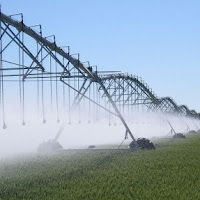
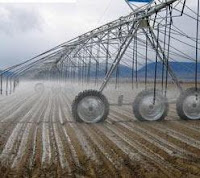
Center pivot machines operate from a pivot point in a field. A galvanized steel framework lined with hanging sprinklers rotates around the center pivot; drive wheels which move the frame are powered by electric motors. A main pipe attached to the center pivot carries the water under pressure to the sprinklers.

A center pivot system requires less mechanical maintenance than a linear self-propelled system and has a longer lifespan than drip systems. It is adaptable to most field and grain crops; even trees in some cases.

Wednesday, August 5, 2009

Big return in corn

Center Pivot SystemWhen it came to deciding whether or not to spend $120,000 to install a center pivot in an area where the systems are a rarity, “We had to do some serious thinking,” says John Grant, who farms hill land in north central Mississippi.

John Grant, and his son, Kenneth, say the difference in corn yield over dryland in 2008 helped them pay almost half the cost of installing a center pivot system on a 170-acre field. They’re hoping to recoup the rest of the cost this year.

Drilling wells in the area is an expensive — and often futile — proposition, given the depths required to try and get adequate water to run an irrigation system. Grant and his son, Kenneth, who farms with him, had a go at drilling a well on a field where they planned to grow corn in 2008, but called it quits when they got to 600 feet and still couldn’t get sufficient water to run a center pivot. They weren’t ready to give up on irrigation, though.

“Bogue Creek runs along one edge of the field,” says John. “You can walk across it in most places and not get too wet, and just to look at it, you wouldn’t think there’s enough water flow to support a quarter-mile center pivot. But, it doesn’t go dry in the summer, and when we checked the flow, it averaged 3,000 gallons per minute. The pivot would require only 1,000 gallons per minute.

“We worked with the Big D folks at Greenwood, Miss., to design a Valley system that would pump water from the creek, uphill through an underground line, to the pivot". “We had to pay the electric company $9,600 to run a line to power the pump in the creek and the pivot, but when we looked at operating costs, electricity was much less than diesel.

“We ran the system 16 days last year, and we’ve already used it several times this season. It takes 36 hours to make a full circle on 167 acres, putting down a half-inch of water.”

When harvest time came, says John, any reservations they may have had about the irrigation investment vanished. “We averaged 195 bushels on the field, and the yield monitor on the combine was showing some spots with 230 bushels. On areas outside the pivot, we averaged 54 bushels. With the price we got for our corn, we figure we recouped half the cost of the system in just one year". “If corn prices hold this year, and we’ve already got a lot of it booked, we’ll likely make back the rest of what it cost us. As soon as we get this pivot paid for, we’ll look at putting in another.”