World's population is growing quickly, and we're not only talking about adding more people, we're talking about more people with better lives. Wednesday, October 1, 2014
Agriculture faces a big challenge
World's population is growing quickly, and we're not only talking about adding more people, we're talking about more people with better lives. Friday, September 12, 2014
The best crop insurance is irrigation

Friday, July 26, 2013
Pivot irrigation systems are bad for roads

Tuesday, November 13, 2012
Lower levels of arsenic in rice
By using pivot irrigation
Tuesday, June 12, 2012
Electric pivots versus hydrostatic systems

Center pivot systems were originally designed to operate on square fields. With the introduction of electric drive machines, center pivots started to be used on many field shapes.
T-L Irrigation manufactures hydrostatic Pivots, (the machine is powered by water propelling the pivot around the field).
The other manufacturers' equipment is powered by 480 volt electricity. The propelling motors and other equipment start and move forward when told to do so by sensors, not in a continuous motion.
Center-Pivot irrigation: benefits to the crop
The sprinkler heads are positioned along its length. There are many different nozzle configurations available. Big guns can be placed at the end of the pivot overhang to allow the water system to reach even the farthest edges of a field.
Typically pivots work on flat fields, but even fields can benefit from this type of irrigation system. Many farmers are finding that center pivot irrigation satisfies many of their crops' consistent water needs.
Friday, January 27, 2012
Pivot irrigation in Georgia
In Southwest Georgia there are more than 6,000 center pivots used to water peanuts, cotton and corn. Farmers have control over how much water the irrigation nozzles spray as they pass over fields. Small fields can vary in topography and soil types, with some places wetter or drier than other places in the same field.VRI technology
Growers want to irrigate more precisely, but don't have the time or level with higher-tech gadgets. The more time-consuming technology steps have been eliminated to make the system easier for farmers to use.
Instead of having to create computer maps of fields, this system has a simple "push-button" feature. A farmer can start the center pivot over a field. When it gets to a location he doesn't want to apply water, the farmer pushes the button to train the system not to water that area. Once the system passes this area, he pushes the button again to resume watering only the crop. This can be done in as many as 8 locations in the same field.
The water efficiency of VRI has been tested on farms in Georgia and found it can reduce the water use in a field by as much as 15% annually without sacrificing crop yield.
Tuesday, November 22, 2011
Record yields on rice fields
A production of rice under center-Pivot irrigation systems, located in Missouri (United States) reached record yields. While the majority of fields were well-suited for flood irrigation, one field had sandy loam soils and hilly terrain, which previously made it impossible to produce rice. The kind of soil cannot maintain a flood, so Pivot irrigation is a good alternative. It was the first experience with rice for the producer, but it didn't mean more work than in the corn field. They just ran the center-Pivot more time.A grower who produces rice with a center pivot can be 5% more profitable than if he had flooded his field. Data collected throughout the years, on traditional and non-traditional rice fields, have recorded cost savings that rice producers have experienced with center pivot irrigation and linear machines versus flood.
Though a rice producer may use more pesticides and herbicides with a center pivot, the fertilizer costs remain the same as with a flooded field. Because a rice field irrigated with a center pivot does not need to be flat, and crop protection products can be applied through the irrigation machine, growers may see a 75 percent or more difference in labor costs, and a 50 percent or more difference in maintenance costs. Compared with a flooded field, fuel costs are also lower for rice produced with a center pivot due to a significantly smaller volume of water that is pumped throughout the growing season.
Friday, August 26, 2011
What's so great about Pivot irrigation?
Benefits to irrigating crops with a center Pivot
There are two major benefits to a Pivot system. The first is simply that plants receive water on a regular, consistent basis. Pivot irrigation systems allow plants to receive water every 3 days, on average. This allows the water to soak into the ground, promoting deep root growth which in turn encourages healthy plants.
The second benefit to a center pivot is that water loss because of evaporation and drifting in the breeze is minimized. Pivots allow the sprinkler heads to be lowered to just inches above the tops of the plants, thus ensuring that most of the water reaches the crop and doesn't blow away in the wind. Water conservation is a serious concern today. Evaporation and wind drift are a concern also because many farmers are allowed a limited amount of moisture to get their crops to harvest.
Varied Terrain is Okay for Pivot Irrigation
Center pivots offer the ability to irrigate fields that have surface slopes that make it impossible to irrigate with surface methods. Many crops benefit from this type of watering system: alfalfa, corn, soybeans, sunflowers and more do very well with Pivots.Monday, August 1, 2011
Center-Pivot systems and lateral move irrigation machines
Most center pivot systems now have drops hanging from goosenecks attached at the top of the pipe with sprinkler heads that are positioned a few feet above the crop, thus limiting evaporative losses and wind drift. Pressure regulators are typically installed upstream of each nozzle to ensure each is operating at the correct design pressure.
Crops may be planted in straight rows or are sometimes planted in circles to conform to the travel of the center pivot.
Originally, most center pivots were water-powered. These were replaced by hydraulic systems and electric motor-driven systems. Most systems today are driven by an electric motor mounted at each tower.
For center pivot to be used, the terrain needs to be reasonably flat; but one major advantage of center pivots over alternative systems is the ability to function in undulating country. This advantage has resulted in increased irrigated acreage and water use in some areas.
Linear/Lateral Move Irrigation Machines
The motor and pump equipment is mounted on a cart adjacent to the supply channel that travels with the machine. Farmers may opt for linear moves to conform to existing rectangular field designs such as those converting from furrow irrigation.
Lateral moves are far less common, rely on more complex guidance systems and require additional management than compared to centre pivot systems.
Monday, July 11, 2011
Center pivot irrigation on the California State University
Specialists will oversee demonstrations, as well as tests comparing the center pivot system to flood and other types of sprinkler and drip irrigation systems. Tests will address water use efficiency, energy use and crop performance.
The flood irrigation mentality is ingrained in people in this area, so this demonstration plot will show what a pivot system can do. Center pivot irrigation technology goes back decades, and it is used extensively all over the world. For some reasons, it has not been widely adopted in California but nowadays, growers are getting more interested in reducing costs and enhancing efficiency.
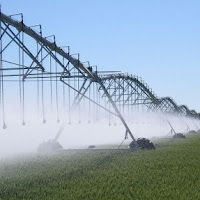
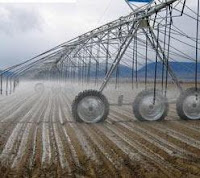
Center pivot machines operate from a pivot point in a field. A galvanized steel framework lined with hanging sprinklers rotates around the center pivot; drive wheels which move the frame are powered by electric motors. A main pipe attached to the center pivot carries the water under pressure to the sprinklers.
A center pivot system requires less mechanical maintenance than a linear self-propelled system and has a longer lifespan than drip systems. It is adaptable to most field and grain crops; even trees in some cases.
Wednesday, May 4, 2011
Cruise control for center-Pivot irrigation
This product is a good demonstration of company's dedication to meeting customers' needs through innovation.
The irrigation industry was asking for a product like this. Now producers can program a center pivot irrigation machine to automatically adjust its speed, based on completing a defined number of degrees in a specific amount of time.
This feature will help producers more precisely manage chemigation and fertigation through their center pivot irrigation equipment. If a center pivot travels too fast during chemigation, it won't be applied enough chemical. If it travels too slowly, the product runs out and a part of the ground goes untreated.
It's a very easy to use product, so simple to operate.
Tuesday, November 30, 2010
Benefits of Pivot irrigation
These systems begin with a water source, usually in the center of a field. This source can be a well, canal, or other consistent water supply. From the water source, pipes or hoses allow the water to be transported along the entire length of a field. Wheeled towers allow the pivot to move slowly around the field.
Sprinkler heads spray or sprinkle the growing crops from the main pipe, or from drops that dangle below the structure just a few inches above the plants.
Two important benefits of pivot irrigation are that crops receive regular, consistent water, and that water evaporation and wind drift are greatly reduced. Besides, Pivot irrigation allows the farmer to determine how much water the plants receive, as well as how often the plants receive that water.
Friday, November 26, 2010
The Nebraska pioneer of center pivot irrigation has died
Mr. Daugherty’s company, originally called Valley Manufacturing, started out making agricultural implements. Now known as Valmont Industries, it became an international manufacturing giant. The breakthrough for Mr. Daugherty came in 1953, when he bought the rights to manufacture a new irrigation system, the brainchild of a Nebraska farmer, Frank Zybach. The new system came to be called center-pivot irrigation. It involved a long pipe on wheels that rotated around a point at the center of a field, spraying water as it went.
Engineers working for Mr. Daugherty improved the system, but he had difficulty at first persuading farmers to try it. By the 1960s, however, it began to take hold. Today, about 42% of irrigated farmland in the United States uses center pivot machinery or similar mechanized systems. Its prevalence can perhaps be best recognized from the air, where travelers on cross-country flights can see the landscape converted into a polka dot pattern of irrigated circles inside square fields.
Before the center pivot, farmers would typically irrigate their fields by allowing water to run downhill in furrows. But the center-pivot system allowed for a much more efficient use of water. It also requires less labor and can be used on uneven or hilly terrain where traditional methods of irrigation may not be an option. It is now used around the world and is credited with expanding the acreage of irrigated land and increasing farm productivity.
Mr. Daugherty, who retired from the company in 1996, left a large part of his fortune to a foundation he created. In April the foundation pledged $50 million to the University of Nebraska to found the Global Water for Food Institute, a center for research and policy analysis related to the use of water for agriculture.
Friday, November 19, 2010
Two center Pivots to put out a cornfield fire
Three fire departments responded to cornfield fire near St. Libory (Illinois, US) last saturday. St. Libory Volunteer Fire Chief Troy Leschinsky said a cornfield fire apparently started by a combine was put out partly with the help of two center pivot irrigation systems that were turned on after the field caught on fire.
Sunday, June 20, 2010
Pivot irrigation in Libya
Saturday, October 31, 2009
Irrigation and Energy Conference
The California Association of Resource Conservation Districts will host a one-day conference to help farmers reduce energy use and increase water use efficiency. It will be held at the AgTAC Energy Center in Tulare.
The conference will provide information and practical experience on numerous innovative precision agricultural technologies. It will highlight recent successful introductions of mechanized irrigation systems.
The morning program offers an overview of emerging "hot button" issues in air and water quality that the agriculture industry faces. These will include groundwater pumping and cost-sharing funds from the USDA. Air and water quality specialists will offer updates on ag-related air and water quality regulations.
Guest speakers will discuss an overview of precision agriculture technologies.
Further discussions will cover mechanized center pivot and linear overhead irrigation systems. These systems are being adopted because they offer high application uniformity, increased automation, and low reliance on labor.
Monday, September 14, 2009
Outdoor Security System
Trap sensors for detecting people
Sensors for risk situations
Applications
Wednesday, August 5, 2009
Big return in corn
John Grant, and his son, Kenneth, say the difference in corn yield over dryland in 2008 helped them pay almost half the cost of installing a center pivot system on a 170-acre field. They’re hoping to recoup the rest of the cost this year.
Drilling wells in the area is an expensive — and often futile — proposition, given the depths required to try and get adequate water to run an irrigation system. Grant and his son, Kenneth, who farms with him, had a go at drilling a well on a field where they planned to grow corn in 2008, but called it quits when they got to 600 feet and still couldn’t get sufficient water to run a center pivot. They weren’t ready to give up on irrigation, though.
“Bogue Creek runs along one edge of the field,” says John. “You can walk across it in most places and not get too wet, and just to look at it, you wouldn’t think there’s enough water flow to support a quarter-mile center pivot. But, it doesn’t go dry in the summer, and when we checked the flow, it averaged 3,000 gallons per minute. The pivot would require only 1,000 gallons per minute.
“We worked with the Big D folks at Greenwood, Miss., to design a Valley system that would pump water from the creek, uphill through an underground line, to the pivot". “We had to pay the electric company $9,600 to run a line to power the pump in the creek and the pivot, but when we looked at operating costs, electricity was much less than diesel.
“We ran the system 16 days last year, and we’ve already used it several times this season. It takes 36 hours to make a full circle on 167 acres, putting down a half-inch of water.”
When harvest time came, says John, any reservations they may have had about the irrigation investment vanished. “We averaged 195 bushels on the field, and the yield monitor on the combine was showing some spots with 230 bushels. On areas outside the pivot, we averaged 54 bushels. With the price we got for our corn, we figure we recouped half the cost of the system in just one year". “If corn prices hold this year, and we’ve already got a lot of it booked, we’ll likely make back the rest of what it cost us. As soon as we get this pivot paid for, we’ll look at putting in another.”
Thursday, July 9, 2009
Vehicle collides with Pivot Irrigation System
Police say a faulty stop arm on the irrigation system – a large metal structure more than a thousand feet long that moves on wheels around a central pivot point to water farm crops – placed it onto Cannon Road between Wesley Church Road and Federalsburg Road, where it was struck by the car traveling east about 2:45 a.m.
The collision left both the vehicle and the irrigation structure inoperable. The occupants fled after removing the license plates from the vehicle, police said.
They said there was no sign anyone was injured. The pivot had to be removed from the vehicle by a towing company, which then removed the vehicle.
The Bridgeville Fire Department and the De Department of Natural Resources and Environmental Control responded to remove hydraulic fluid that spilled onto the road. The road was closed for about two hours.
Wednesday, July 1, 2009
Installation of 23 Center Pivot in Pakistán
The Government of Sindh intends to install 23 Center Pivot Toeable Sprinkler Irrigation Systems, one each of 50 acres, at each district of the province. The list of districts: Hyderabad, Karachi, Thatta, Matiari, Jamshoro, Dadu, Badin, Mirpurkhas, Sanghar, Tando Mohd Khan, Tando Allah Yar, Umer Kot, Nawabshah (Daur), Naushehro Feroze, Khairpur (Nara), Tharparkar, Larkana, Ghotki, Sukkur, Jacobabad, Kambur-Shahdadkot, Kashmore-Kandhkot, Shikarpur.The firms already pre-qualified / short-listed with the Government under WC & PE-HEIS project would be required to:
- Design and prepare material & cost estimates with the consent of farmers
- Get it authenticated from consultants and approved from the Project Director
- Install the complete system on farmers’ fields with all diesel, electrical and water hook-ups / accessories within this financial year 2005-2009
- Operate the system to the satisfaction of the farmers and line agencies on turn-key basis
- Provide O & M for one year, after the installation within estimated cost (warranty period) and from 2nd year to successive five years at an agreed O & M cost
- The firms would be required to provide training to the farmers
The Project Directorate, with the approval of competent authority, reserves the right to accept or reject any or all offers without assigning any reason.