Monday, July 11, 2011

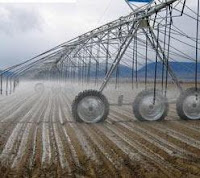
Center pivot irrigation on the California State University

Center-Pivot systemA new center pivot system was installed on the farm of the California State University to serve as a research and educational tool. It was donated by Valmont Irrigation, and it's expected to attract positive attention from the local agricultural industry.

Specialists will oversee demonstrations, as well as tests comparing the center pivot system to flood and other types of sprinkler and drip irrigation systems. Tests will address water use efficiency, energy use and crop performance.

The flood irrigation mentality is ingrained in people in this area, so this demonstration plot will show what a pivot system can do. Center pivot irrigation technology goes back decades, and it is used extensively all over the world. For some reasons, it has not been widely adopted in California but nowadays, growers are getting more interested in reducing costs and enhancing efficiency.

Center pivot machines operate from a pivot point in a field. A galvanized steel framework lined with hanging sprinklers rotates around the center pivot; drive wheels which move the frame are powered by electric motors. A main pipe attached to the center pivot carries the water under pressure to the sprinklers.

A center pivot system requires less mechanical maintenance than a linear self-propelled system and has a longer lifespan than drip systems. It is adaptable to most field and grain crops; even trees in some cases.

Wednesday, May 4, 2011

Cruise control for center-Pivot irrigation

Cruise control for center-Pivot irrigationValley Irrigation introduced a new software that they have called 'Pivot Cruise Control', which allows producers to be more precise with chemigation and fertigation.

This product is a good demonstration of company's dedication to meeting customers' needs through innovation.

The irrigation industry was asking for a product like this. Now producers can program a center pivot irrigation machine to automatically adjust its speed, based on completing a defined number of degrees in a specific amount of time.

This feature will help producers more precisely manage chemigation and fertigation through their center pivot irrigation equipment. If a center pivot travels too fast during chemigation, it won't be applied enough chemical. If it travels too slowly, the product runs out and a part of the ground goes untreated.

It's a very easy to use product, so simple to operate.

Tuesday, November 30, 2010

Benefits of Pivot irrigation

Benefits of Pivot irrigationFlying across the USA everybody can observe center pivot irrigation: the cause for those green or brown circles or half-circles on the earth below. This type of crop watering system is very effective at creating valuable farmland out of previously unusable dry or even desert ground.

These systems begin with a water source, usually in the center of a field. This source can be a well, canal, or other consistent water supply. From the water source, pipes or hoses allow the water to be transported along the entire length of a field. Wheeled towers allow the pivot to move slowly around the field.

Sprinkler heads spray or sprinkle the growing crops from the main pipe, or from drops that dangle below the structure just a few inches above the plants.

Two important benefits of pivot irrigation are that crops receive regular, consistent water, and that water evaporation and wind drift are greatly reduced. Besides, Pivot irrigation allows the farmer to determine how much water the plants receive, as well as how often the plants receive that water.

Water loss is minimized. In dry areas, water evaporation and wind drift can result in a major loss of water to crops. In the high plains where strong winds are common, wind drift can prevent water from reaching the plants on the ground. Also, warm dry air will cause water to evaporate at a much higher rate than other places.

Friday, November 26, 2010

The Nebraska pioneer of center pivot irrigation has died

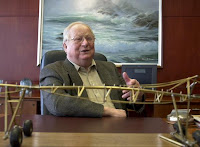
Mr. Daugherty and his center Pivot scaled modelRobert B. Daugherty was a Nebraska businessman who helped transform the rural landscape into a patchwork of circular fields by popularizing an irrigation system that used a pipe on wheels pivoting around a central point. He died on Wednesday at his home in Omaha, he was 88.

Mr. Daugherty’s company, originally called Valley Manufacturing, started out making agricultural implements. Now known as Valmont Industries, it became an international manufacturing giant. The breakthrough for Mr. Daugherty came in 1953, when he bought the rights to manufacture a new irrigation system, the brainchild of a Nebraska farmer, Frank Zybach. The new system came to be called center-pivot irrigation. It involved a long pipe on wheels that rotated around a point at the center of a field, spraying water as it went.

Engineers working for Mr. Daugherty improved the system, but he had difficulty at first persuading farmers to try it. By the 1960s, however, it began to take hold. Today, about 42% of irrigated farmland in the United States uses center pivot machinery or similar mechanized systems. Its prevalence can perhaps be best recognized from the air, where travelers on cross-country flights can see the landscape converted into a polka dot pattern of irrigated circles inside square fields.

Before the center pivot, farmers would typically irrigate their fields by allowing water to run downhill in furrows. But the center-pivot system allowed for a much more efficient use of water. It also requires less labor and can be used on uneven or hilly terrain where traditional methods of irrigation may not be an option. It is now used around the world and is credited with expanding the acreage of irrigated land and increasing farm productivity.

Mr. Daugherty, who retired from the company in 1996, left a large part of his fortune to a foundation he created. In April the foundation pledged $50 million to the University of Nebraska to found the Global Water for Food Institute, a center for research and policy analysis related to the use of water for agriculture.