Tuesday, June 12, 2012

Electric pivots versus hydrostatic systems

Electric pivot systems
There are five major manufacturers of center pivot irrigation systems and irrigation technology: T-L Irrigation, Valley (also known as Valmont Irrigation), Raintex Irrigation, Reinke and the Lindsay Corporation. 
Center pivot systems were originally designed to operate on square fields. With the introduction of electric drive machines, center pivots started to be used on many field shapes.
T-L Irrigation manufactures hydrostatic Pivots, (the machine is powered by water propelling the pivot around the field).

The other manufacturers' equipment is powered by 480 volt electricity. The propelling motors and other equipment start and move forward when told to do so by sensors, not in a continuous motion.

Center-Pivot irrigation: benefits to the crop


Many crops around the world take benefit from center pivot irrigation: soybeans, corn, sunflowers, edible beans, sugar beets, alfalfa, wheat...Center pivots have been used successfully in very large fields, with the pivot itself being as much as one-quarter mile in length.
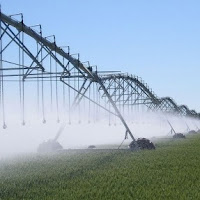
The sprinkler heads are positioned along its length. There are many different nozzle configurations available. Big guns can be placed at the end of the pivot overhang to allow the water system to reach even the farthest edges of a field.

Typically pivots work on flat fields, but even fields can benefit from this type of irrigation system. Many farmers are finding that center pivot irrigation satisfies many of their crops' consistent water needs.

Friday, January 27, 2012

Pivot irrigation in Georgia

Center Pivots in Southwest GeorgiaIn Southwest Georgia there are more than 6,000 center pivots used to water peanuts, cotton and corn. Farmers have control over how much water the irrigation nozzles spray as they pass over fields. Small fields can vary in topography and soil types, with some places wetter or drier than other places in the same field.

VRI technology

The concept is simple: apply water when and where crops need it. Don't apply it where they don't. VRI technology uses computer maps, global positioning systems, soil sensors and software to control where and how much water the nozzles on a center pivot spray on crops.

Growers want to irrigate more precisely, but don't have the time or level with higher-tech gadgets. The more time-consuming technology steps have been eliminated to make the system easier for farmers to use.

Instead of having to create computer maps of fields, this system has a simple "push-button" feature. A farmer can start the center pivot over a field. When it gets to a location he doesn't want to apply water, the farmer pushes the button to train the system not to water that area. Once the system passes this area, he pushes the button again to resume watering only the crop. This can be done in as many as 8 locations in the same field.

The water efficiency of VRI has been tested on farms in Georgia and found it can reduce the water use in a field by as much as 15% annually without sacrificing crop yield.

Tuesday, November 22, 2011

Record yields on rice fields

Center Pivot on rice fieldA production of rice under center-Pivot irrigation systems, located in Missouri (United States) reached record yields. While the majority of fields were well-suited for flood irrigation, one field had sandy loam soils and hilly terrain, which previously made it impossible to produce rice. The kind of soil cannot maintain a flood, so Pivot irrigation is a good alternative. It was the first experience with rice for the producer, but it didn't mean more work than in the corn field. They just ran the center-Pivot more time.

A grower who produces rice with a center pivot can be 5% more profitable than if he had flooded his field. Data collected throughout the years, on traditional and non-traditional rice fields, have recorded cost savings that rice producers have experienced with center pivot irrigation and linear machines versus flood.

Though a rice producer may use more pesticides and herbicides with a center pivot, the fertilizer costs remain the same as with a flooded field. Because a rice field irrigated with a center pivot does not need to be flat, and crop protection products can be applied through the irrigation machine, growers may see a 75 percent or more difference in labor costs, and a 50 percent or more difference in maintenance costs. Compared with a flooded field, fuel costs are also lower for rice produced with a center pivot due to a significantly smaller volume of water that is pumped throughout the growing season.

Friday, August 26, 2011

What's so great about Pivot irrigation?

Benefits to irrigating crops with a center Pivot

Pivot irrigationFlying across the USA, passengers notice green circles and half-circles, on the ground below. Those circles are created when a farmer waters his crops with Pivot irrigation.

There are two major benefits to a Pivot system. The first is simply that plants receive water on a regular, consistent basis. Pivot irrigation systems allow plants to receive water every 3 days, on average. This allows the water to soak into the ground, promoting deep root growth which in turn encourages healthy plants.

The second benefit to a center pivot is that water loss because of evaporation and drifting in the breeze is minimized. Pivots allow the sprinkler heads to be lowered to just inches above the tops of the plants, thus ensuring that most of the water reaches the crop and doesn't blow away in the wind. Water conservation is a serious concern today. Evaporation and wind drift are a concern also because many farmers are allowed a limited amount of moisture to get their crops to harvest.

Varied Terrain is Okay for Pivot Irrigation

Center pivots offer the ability to irrigate fields that have surface slopes that make it impossible to irrigate with surface methods. Many crops benefit from this type of watering system: alfalfa, corn, soybeans, sunflowers and more do very well with Pivots.