Showing posts with label spray nozzle. Show all posts

Tuesday, June 12, 2012

Electric pivots versus hydrostatic systems

Electric pivot systems
There are five major manufacturers of center pivot irrigation systems and irrigation technology: T-L Irrigation, Valley (also known as Valmont Irrigation), Raintex Irrigation, Reinke and the Lindsay Corporation. 
Center pivot systems were originally designed to operate on square fields. With the introduction of electric drive machines, center pivots started to be used on many field shapes.
T-L Irrigation manufactures hydrostatic Pivots, (the machine is powered by water propelling the pivot around the field).

The other manufacturers' equipment is powered by 480 volt electricity. The propelling motors and other equipment start and move forward when told to do so by sensors, not in a continuous motion.

Center-Pivot irrigation: benefits to the crop


Many crops around the world take benefit from center pivot irrigation: soybeans, corn, sunflowers, edible beans, sugar beets, alfalfa, wheat...Center pivots have been used successfully in very large fields, with the pivot itself being as much as one-quarter mile in length.
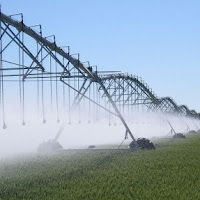
The sprinkler heads are positioned along its length. There are many different nozzle configurations available. Big guns can be placed at the end of the pivot overhang to allow the water system to reach even the farthest edges of a field.

Typically pivots work on flat fields, but even fields can benefit from this type of irrigation system. Many farmers are finding that center pivot irrigation satisfies many of their crops' consistent water needs.

Friday, January 27, 2012

Pivot irrigation in Georgia

Center Pivots in Southwest GeorgiaIn Southwest Georgia there are more than 6,000 center pivots used to water peanuts, cotton and corn. Farmers have control over how much water the irrigation nozzles spray as they pass over fields. Small fields can vary in topography and soil types, with some places wetter or drier than other places in the same field.

VRI technology

The concept is simple: apply water when and where crops need it. Don't apply it where they don't. VRI technology uses computer maps, global positioning systems, soil sensors and software to control where and how much water the nozzles on a center pivot spray on crops.

Growers want to irrigate more precisely, but don't have the time or level with higher-tech gadgets. The more time-consuming technology steps have been eliminated to make the system easier for farmers to use.

Instead of having to create computer maps of fields, this system has a simple "push-button" feature. A farmer can start the center pivot over a field. When it gets to a location he doesn't want to apply water, the farmer pushes the button to train the system not to water that area. Once the system passes this area, he pushes the button again to resume watering only the crop. This can be done in as many as 8 locations in the same field.

The water efficiency of VRI has been tested on farms in Georgia and found it can reduce the water use in a field by as much as 15% annually without sacrificing crop yield.

Wednesday, October 15, 2008

Fathers of Center Pivot Irrigation (IV)

Valmont Industries, Inc.
Valley Manufacturing Company (Valmont Industries, Inc.) was founded in 1946 by Robert Daugherty.
He invested his entire life savings to start the company, which manufactured farm elevators, hay rakes, wagon hoists and tractor front end loaders.
In 1954, he acquired patented manufacturing and sales rights for self-propelled irrigation system from farmer Frank Zybach.
Advancements in technology like linear move systems, hot dip galvanizing, low-pressure nozzles, and computerized pivot panels has made Valmont the largest manufacturer of center pivots in the world.

Friday, September 5, 2008

Center Pivot Sprinklers

Sprinkler manufacturers have developed and marketed a large number of different sprinkler technologies that produce relatively large wetted diameters at reduced pressures.Thus, center pivot operators have a greater number of sprinkler packages to meet goals of reduced wind drift, reduced energy costs and increased water application efficiency.
The goal of every sprinkler or spray nozzle package is to apply water uniformly to the soil surface where it can be used by plants to produce grain or dry matter.Some performance characteristics can affect the suitability of a package for a specific set of field conditions.
Each sprinkler is designed to operate within a range of water pressures. Tipically, impact sprinklers can be operated over a wide range of pressures than low pressure spray nozzles.
One of the more recent changes resulting from new nozzle designs is related to water application patterns.The design process sought to achieve the largest wetted diameter and lowest operating pressure combination possible.