
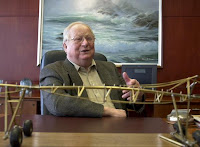
 Robert B. Daugherty was a Nebraska businessman who helped transform the rural landscape into a patchwork of circular fields by popularizing an irrigation system that used a pipe on wheels pivoting around a central point. He died on Wednesday at his home in Omaha, he was 88.
Mr. Daugherty’s company, originally called Valley Manufacturing, started out making agricultural implements. Now known as Valmont Industries, it became an international manufacturing giant. The breakthrough for Mr. Daugherty came in 1953, when he bought the rights to manufacture a new irrigation system, the brainchild of a Nebraska farmer, Frank Zybach. The new system came to be called center-pivot irrigation. It involved a long pipe on wheels that rotated around a point at the center of a field, spraying water as it went.
Engineers working for Mr. Daugherty improved the system, but he had difficulty at first persuading farmers to try it. By the 1960s, however, it began to take hold. Today, about 42% of irrigated farmland in the United States uses center pivot machinery or similar mechanized systems. Its prevalence can perhaps be best recognized from the air, where travelers on cross-country flights can see the landscape converted into a polka dot pattern of irrigated circles inside square fields.
Before the center pivot, farmers would typically irrigate their fields by allowing water to run downhill in furrows. But the center-pivot system allowed for a much more efficient use of water. It also requires less labor and can be used on uneven or hilly terrain where traditional methods of irrigation may not be an option. It is now used around the world and is credited with expanding the acreage of irrigated land and increasing farm productivity.
Mr. Daugherty, who retired from the company in 1996, left a large part of his fortune to a foundation he created. In April the foundation pledged $50 million to the University of Nebraska to found the Global Water for Food Institute, a center for research and policy analysis related to the use of water for agriculture.

